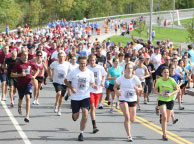
Image courtesy of (ariel)
As a runner, I am constantly looking for ways to decrease the necessity for rest while increasing my ability to recover. Part of the reason is that I don’t want to be sore all of the time, and finding the correct training and recovery balance is important for that. The other part of the equation is that I want to recover faster so that my body can take more pain…which means I have more time to train.
I don’t like rest days…I hate them. I’m born to run and any day spent without some sort of physical activity is one in which I just don’t feel as accomplished as the days before. Sure, you could say that running might be an unhealthy addiction, but compared to other self-medications, like booze or drugs, I’m OK with my running habit.
So with that being said, I’d like to discuss 5 ways that I’ve been able to train my body to recover faster.
Runners need to spend as much time thinking about recovery as they do about training. It might not be as sexy, but ensuring a speedy recovery will help you to reap as much benefit as possible from your workouts. After all, what’s the point of training if your body cannot take advantage of it?

On top of special access to unreleased training guides, we are please to announce a new series of videos designed to help you get the most out of your training. These videos are secret and for subscribers only, so to get your hands on them sign up below!
Subscribe to our newsletter to be notified of all the latest features and content. You’ll be eligible for special promotions and have first access to new site tools. Your privacy is respected and we will not share your email address with any 3rd parties.
Get insider access to special tools and products before they are released to the public, including runner’s podcasts and training guides.
When I first saw the title of this book, I expected it to be full of fluff and not much substance. I’ve read a lot of books on how to prepare for different levels of racing and more often than not I’ve been disappointed with the result.
I decided to give this one a try, hoping that it would change my experience and give me some new tips to incorporate into my training. I’ve seen the sales numbers for The Marathon Method, so I knew it was selling - but was it really worthy buying?
Well, before I answer that question, let me tell you a little about the book. The content runs at an impressive 70 plus pages, which is astounding for an E-Book. It is broken down into several easy to read chapters, with tips at the bottom of almost every page.
In total, there are 17 chapters in all, with 15 of them actual content about running. There are some great training plans inside, as well as nutritional tips, training tips, and race day strategy. The author has even included some great psychological tips to help you break through the training barriers and learn how to train and race effectively.
The Marathon Method is an impressive book. In fact, it is so full of good information that I’ve been going back to it almost daily to learn more. Even though I am an experienced runner, there are still several good portions of the book that brought a new perspective on some of my old training methods.
If you are looking to run a marathon, but aren’t sure how to start training, then this is a perfect book for you. Even if you are a runner and you are just looking for a few nutritional or training tips to help you set a new PR, then you’ll really enjoy The Marathon Method.
If you can’t afford a personal coach, then buying a guide like this one is important to create a solid and achievable plan. If you would like to learn how you can pick up your own copy, then click here to read more.

It’s bound to happen to you sooner or later. Training has gone well and you started to see moderate increases in stamina and skill, but now you want to go faster. It was probably a fair amount per to groaning as I started to get addicted to the feeling of accomplishment and so I started to try to find ways to continue to improve. One of the things that I want to improve upon was my speed, which was pretty weak to say the least. At the time, I could run for an hour or so, but when it came time to pick up the pace, I just couldn’t make it happen. Eventually, after trying a few different methods, I was able to find something that works for me and I still use it today.
Many runners talk about using intervals or fartlek runs to improve speed, but if you’re an endurance athlete like me than short 100 400 or 800 m intervals just don’t cut it. For one thing, a lot of people can’t seem to give the effort required to make intervals worthwhile. In regards to fartlek runs, a lot of runners will pace themselves to fast during the beginning of the run and be able to increase their speed during the fartlek intervals. What I found worked best for me, is to use accommodation of heart rate and zone intensity training.
Coming by the step of training, is to calculate your max heart rate and your max intensity that you can sustain during a short interval and use that as a baseline for maximum effort. Most of us have an idea of what it takes to max out as well it feels like to maintain an easy pace. The problem with running an easy pace is that when it comes to race day, you’ll have the extra gas that you need to turn it into high gear. If you learn to train like you race, then you’re much more likely to be with increasing intensity when it really counts.
So here’s what I recommend:
If it seems hard at first to train at a level 3 or 4 intensity, then it means you’re doing it right. If you really want to get faster, then you have to move out of the comfortable runs and into more intense runs. This is especially true if you want to get into racing competitively. Just remember, the more work that you put in during your run, the more you will improve afterwards.

Now that the Winter is upon us and for many of us the race season has come to a close, it is time to start thinking about building a solid mileage base for next Spring. This is especially important if you’ve qualified for the Boston Marathon or something similar (although outside of a race overseas or a triathlon, I’m not sure I can think of anything similar) and you need to improve your endurance and cardiovascular stamina.
By building a solid mileage base now, you will be better served by your speed work in the Spring and your race times will undoubtedly improve. Let’s say you are running 10k a week now and you want to run 15k a week, or rather than running half-marathon distances on a weekly basis you want to run full marathon distances. Winter base building is the perfect off-season training strategy for you.
The golden rule in building a mileage base is not to increase your weekly mileage by more than 10% at a time. This is important to prevent over-training and injury. Although I have broken this rule on several occasions, considering the time available there is no reason to rush yourself or risk injury.
I recommend alternating between light and difficult runs and adding no more than 1-2 miles per week to your long run. For example, let’s say that you are currently running 20 miles per week and want to increase your weekly mileage to 30 miles per week.
As you can see, using the 10% method you can achieve an increase of 10 miles per week in just 4 weeks. I didn’t count week 1 because I assume that is what you are already doing. If you don’t have time for 4 run days per week, you could still apply the same strategy and simply adjust the numbers where needed. You can also apply the same strategy for a larger number of miles, such as when attempting to move from half-marathon prep to full marathon prep. The key is to simply be consistent so that your body adapts to the increased load, and to make sure you take advantage of the long runs. The long runs are very important for building the cardiovascular and slow-twitch base needed for the Spring.
This is also an excellent tool for new or beginner runners who are looking to simply run their first race, whether it be a 5k, 10k, half-marathon, or full marathon. By effectively building a solid mileage base, you are increasing your ability to endure over long runs. That part is fairly straightforward, however the added benefit is that when you start your speed work in late Winter or early Spring, you will have stronger legs and lungs, which will incrementally increase your ability to perform under stress during interval workouts or other speed drills. The goal for most of us is setting a new PR, and this is the strategy that will help you do that.
Even if you don’t plan on running longer races, I still strongly encourage you to give this method a try. An increase of just a few miles can make a big difference when Spring rolls around. If you are comfortable running a half-marathon, then just think of how easy a 10k will feel!
When the Spring nears, we will talk more about speed drills and interval workouts to fine tune your speed for Spring race season, but until then get outside and start building up those lungs!

The following is a guest post from Charlene Jaszewski, a fellow runner and resident of New York City. This is a great post about a problem that most of us deal with from time to time. Make sure to leave a comment at the end of the post.
If you’re like me (and god help you if you are), your number one problem on a run is not coming up with enough energy to complete your run, it’s keeping your mind from going crazy during the run. If you’re just running 45 minutes, it’s easy enough to keep your mind entertained with scenery on the way out and back. But once you start pushing your mileage up up and away, it becomes more important for you to keep your brain in check. Here are some methods I use.
If you listen to the iPod Nano, you can define a “Power Song” that you can pull up in those instances where you need an extra kick.
Mantras are words repeated during meditation to calm and control the mind. I discovered mantras during a failed attempt at a meditation practice. However, I found by accident that a speeded-up mantra DOES work while running. Obviously “OM” doesn’t work for this purpose, but the Hare Krishna one does. It goes like this:
Hare krishna hare krishna
krishna krishna hare hare
hare rama hare rama
rama rama hare hare
Here’s how it works. Run in an area with other folks (easy enough to do in the city where I live) - in your sights, find someone who is running ahead of you, but JUST A HAIR FASTER. He/she is your rabbit. Make it a challenge to catch up to them. If you’re feeling ballsy, you can even try to pass them, but don’t get too cocky. And don’t make it apparent that you’re chasing them or you might creep them out. Then again if you do, they will run away faster, creating an even greater challenge for you.
One recent rabbit and I did a speed/up slowdown for almost 45 minutes - I would catch up to/pass them, then when I would slow down, they would speed up/pass me. Glorious! And unless your rabbit is extraordinarily cute and you want to have a post-rabbit conversation, you don’t even need to say “thanks for being my rabbit.”
*Only to be undertaken by the very agile and quick, requires dense population and wide sidewalks
Part of my run home involves three long city blocks near Central Park. The sidewalks are very wide (10-15 ft) and there are pockets of people every 20 feet. While running home, it’s necessary to zig and zag between people to keep up my pace. But now instead of zigging when I have to, I CREATE zigzag situations. Like a pocket of people only five feet spread instead of ten. It’s really fun because not only do i get the workout benefit of varying my speed, I get the mental challenge of estimating the ideal speed/trajectory to avoid plowing people over.
Charlene Jaszewski is a freelance communication optimizer who lives in New York City a stone’s throw from Central Park, just the way she likes it. You can read her thoughts on social media, usability and randomness at www.theredheadsaid.com.
Tweet This Post links powered by Tweet This v1.3.9, a WordPress plugin for Twitter.